Most people try to bridge the gap with notes, screenshots, or mental summaries. It works — kind of. But something always gets lost. What if your therapist could see your thoughts exactly as you wrote them, in the moment?

Therapy doesn't just happen during your session. The real insights show up in the moments in between. But by the time your next session comes around, those thoughts are blurry, edited, half-forgotten.
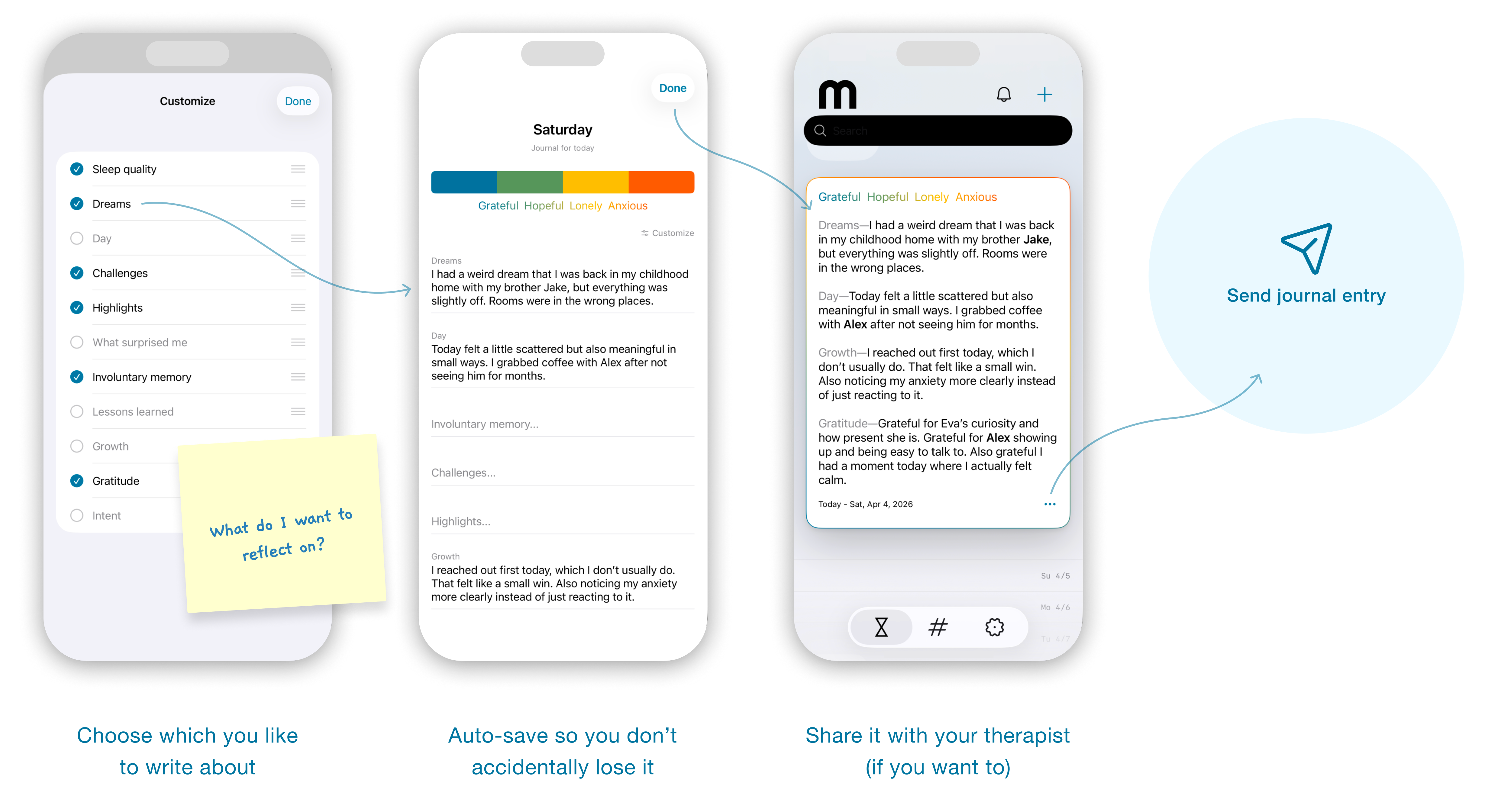
Most people try to bridge the gap with notes, screenshots, or mental summaries. It works — kind of. But something always gets lost. What if your therapist could see your thoughts exactly as you wrote them, in the moment?
Therapy journaling is writing down your thoughts and feelings between sessions to capture raw emotion in the moment rather than reconstructed versions at your next appointment. It's not a replacement for therapy — it's a way to capture what's happening in real time so you and your therapist have better material to work with.
Emotions shift and details fade. By the time your next session arrives, you're often reconstructing what happened rather than reporting it. A journal entry written in the moment preserves the raw signal — the frustration, the relief, the confusion — before your brain tidies it up.
Therapists consistently report that clients who journal between sessions arrive better prepared, use session time more efficiently, and make faster progress. Practices like gratitude journaling can be especially effective, giving both you and your therapist concrete material to work with. The journal becomes a bridge between sessions, not just a record.
Most people forget what they felt between sessions, not because they don't care, but because memory distorts emotion over time. By the time you sit down with your therapist, emotions have been filtered through days of thinking, rationalizing, and moving on. What felt urgent on Monday feels manageable by Friday — except your therapist needs to understand what you actually felt on Monday.
Writing in the moment preserves signal. Sharing those entries creates accountability and continuity. Your therapist no longer has to work backward from memory; they have the real-time data from your life between sessions. This changes the quality of the conversation.
Studies in therapy and psychology consistently show that clients who journal between sessions make faster progress because they arrive with better material and clearer patterns. It's not about having more to say — it's about saying what actually happened instead of what you remember happening.
Effective therapy journaling captures raw emotions in the moment, using guided prompts or event-based entries that you can share with your therapist when relevant.
The most useful therapy journal entries are written in the moment and include specific details about what happened and how you felt, not reconstructed summaries of events. The difference between a useful therapy journal entry and one that doesn't help much usually comes down to timing and specificity.
I think I was upset about what my partner said this week
My partner said I 'always overreact' during dinner tonight. I shut down and didn't say anything. I'm still feeling it three hours later.
I've been anxious lately
Woke up at 4am with my chest tight. Couldn't stop thinking about the presentation on Friday. Wrote this instead of lying there.
Things have been better recently
Went to lunch with Sarah today and realized I didn't check my phone once. First time I've felt genuinely relaxed in weeks.
Real-time entries give your therapist signal. Reconstructed summaries give them noise.
With memorist, you can send a journal entry directly to your therapist in seconds by tapping the three-dot menu and choosing Send journal entry—no copying, no exporting. Just tap the three-dot menu on any Day Journal entry, choose Send journal entry, and your iPhone's native share menu opens. Choose email or text, and your entry is already formatted and ready to send.
No copying. No exporting. No friction.
Sharing journal entries with your therapist reduces memory distortion, saves session time, and gives both of you a clear record of what actually happened and how you felt.
Your therapist sees what you felt, not what you remember feeling. A journal entry written in the moment captures emotion before your brain edits it.
Less time catching up, more time working through what matters. Your therapist arrives with context instead of starting from scratch.
Sharing an entry takes seconds; reconstructing a week takes ten minutes of session time. Your therapy budget goes further.
Your therapist can see patterns across sessions that neither of you might notice in conversation alone. The entries build a picture of your week that memory can't.
Your journal is protected with end-to-end encryption and stays private by default—nothing leaves your device unless you explicitly choose to share it. Your journal stays private by default. Nothing is shared unless you choose to send it. When you do, it goes through your own apps — your email, your messages, your control. memorist never sees who you share with or what you send.
Your entries are protected with end-to-end encryption, so even memorist can't read what you've written. You can journal without an account and maintain complete privacy. For a deeper look at what makes a journal app truly private, or to see how memorist's encryption compares to other journaling apps, we've covered both in detail.
Therapy journaling completes a powerful loop: you write in the moment, reflect between sessions, share with your therapist when it matters, and grow from the conversation. If you're using journaling as part of your therapy, this changes the loop: write, reflect, share, grow. Your thoughts don't have to stay on the page. When you're ready, they can become part of the conversation.
With memorist, you can capture your day in 60 seconds using guided prompts. The share feature is built in — no extra steps, no friction. Just journal, reflect, and send when it matters.
Sharing your therapy journal entries is just one part of the bigger picture of meaningful journaling. If you're working on relationships and showing up for people who matter, Tempo helps you track how you're showing up in your connections alongside your personal reflection work.
Ready to capture the real-time thinking your therapist needs to see? Download memorist and start sharing in seconds.
Start journaling with memorist today